Which one is better? Hardware-based vs. Software-based Video Wall Control
Video wall setups help your company create cohesive, large-scale displays by combining many screens that work in tandem. These could be controlled via PC software or dedicated hardware systems; both approaches come with their pros and cons.
In this post, we’ll look at hardware-based vs. software-based video wall control and see which is better for your company.

The Core Dilemma: Hardware or Software?
This is ultimately a question about reliability or flexibility. The two main options here are:
● Hardware, which offers strong performance and low latency. However, it costs more and isn’t always so easy to upgrade or scale over time.
● Software, which is scalable, cheaper, and more flexible. However, PCs aren’t designed for video walls, which can result in stability issues.
Software solutions manage and distribute video signals to ensure a clear, synchronized wall - it might even pass the signal through the network. Hardware-based walls typically consist of video wall controllers and processors, which handle scaling, splitting, and distribution entirely natively.
Architecture Matters: Silicon-Level vs. OS-Based Processing
Video wall hardware mainly depends on dedicated chips and field-programmable gate arrays (or FPGAs), which split and scale the signals before they reach the OS. The video wall’s controllers and processors generally have proprietary technology optimized for real-time video.
Silicon-level architecture offers:
● Deterministic and predictable performance (ideal for live environments)
● Independence from the operating system (even if the OS crashes)
● High throughput (silicon can handle multiple 4K/8K streams at once)
● Lower overhead (the CPU can focus on other, non-video tasks)
Meanwhile, OS-based video walls rely on an application running on the computer’s OS, typically Windows or Linux. The CPU and GPU mainly handle the scaling and splitting, which means the wall’s performance often depends on the computer’s current load.
OS-based architecture offers:
● Flexibility, such as the ability to add new content types and networked sources
● Extra scalability, though you will eventually run into the CPU/GPU’s upper limit
Also, as mentioned above, any OS issues - such as crashes, updates, and high CPU load - can affect the whole setup.
Real-Time Performance: Subframe Latency in Hardware Architecture
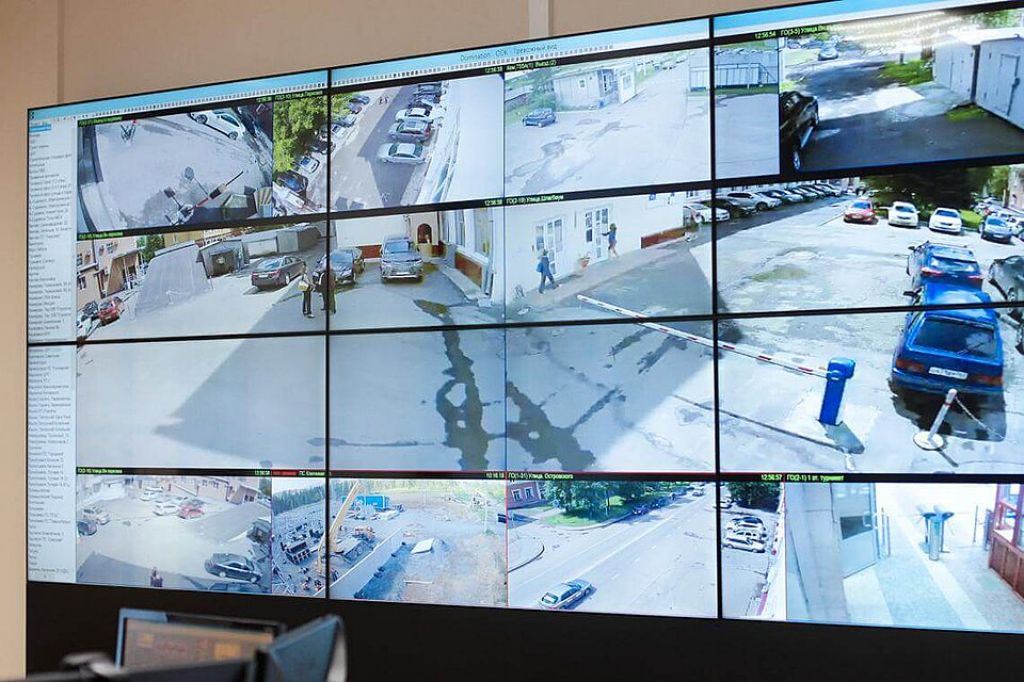
Video walls often display live information, including security camera feeds, traffic data, and even news broadcasts. Even a few frames of lag can affect a live broadcast or delay a security team’s response; luckily, hardware-based video walls usually have subframe latency.
Subframe latency is when the system processes and displays video with less than one frame of delay. With 4K60 displays, one frame usually lasts 16.67 milliseconds. If the wall setup adds, for example, 2-8 ms of delay, it offers subframe latency.
Hardware-based controllers can achieve this by processing pixels as they stream in, line by line or pixel by pixel. The image can start appearing on the wall before it receives the full frame.
(Source: https://commons.wikimedia.org/wiki/File:Видеостена_CleverMic_в_действующем_мониторинговом_центре.jpg)

Why Mission-Critical Systems Cannot Risk an OS Crash
Simply put, an OS crash will take down the entire video wall. If your team relies on this setup for live feeds or data, they could have at least a few minutes of downtime. Depending on the crash, it could be offline for hours or until a technician fixes things.
Here are a few examples of how this looks in practice:
● Security rooms won’t know if there’s an ongoing crisis
● Air traffic control centers can’t see where planes are
● 999 dispatchers can’t monitor ongoing incidents as well
● Power grid control rooms can’t check load conditions
● Broadcasting stations might have to deal with dead air
Operational stability is paramount here; even delays of seconds could lead to unnoticed security incidents or even plane crashes.
Hardware-Based vs. Software-Based Control
Here is a closer look at how hardware-centric and software-centric video wall systems compare to one another:
| Category | Hardware | Software |
| Latency | Ultra-low, usually subframe | Often 1-3 frames |
| Consistency | Deterministic and stable | Depends on CPU/GPU |
| Uptime | Designed for 24/7 operation | Requires careful monitoring |
| Scalability | Requires extra hardware | Easy to scale natively |
| Flexibility | New features may require upgrades | Updates can add new built-in features |
| IT integration | Moderate, but limited | Strong, can link to IT APIs |
| Overall costs | High upfront cost, but stable long-term fees | Low upfront cost, but more extra fees over time |
| Use cases | Control rooms, broadcasting, mission-critical setups | Digital signage, corporate displays, events |
Here, we can see that hardware offers stronger overall performance and virtually no delay at the cost of some long-term flexibility and quality-of-life features.
Is hardware better than software for video walls?
Yes, hardware-based video wall systems are purpose-built to facilitate video walls and their 24/7 operations. Software-based systems might seem simpler and cheaper, but they’re notably more vulnerable to crashes, cyberattacks, and other performance issues.
.png) |
 |
| DVP500 Video Processor | DMX302x Matrix Switcher |
Cybersecurity: The Advantage of Hardware-Based Architecture in 2026
Software-based video walls usually rely on a PC that’s connected to the company’s network, so they’re still vulnerable to malware, phishing, and other online threats. Hardware setups are able to avoid this because they have fewer components, none of which leave room for intrusions.
Some vulnerabilities are introduced via updates, and hardware-based tech usually only needs to be updated with each new firmware release. Meanwhile, software-based solutions often require more frequent patches, which could introduce new flaws that hackers can exploit.
Many hardware-based approaches offer innovative features that help maintain system security. DEXON Systems’ video wall processors/controllers, for example, use embedded management software. This creates a narrow control layer that only helps configure the device, separating it from the OS while simplifying the video wall’s GUI.
Choosing the Right Foundation with DEXON
DEXON’s hardware-based video walls are a great addition to any mission-critical AV setting, as a software-based alternative is simply too unreliable. No matter your sector, you’ll need a video wall that prioritizes performance - that’s exactly what DEXON offers.
Get in touch today to learn more about our video wall solutions and how they can help you.