What Makes SDVoE Different? A New Way to Build Flexible AV Systems
Software-Defined Video over Ethernet is an innovative type of audiovisual technology that could change how you build your AV tech stack. In this post, we’ll look at what sets SDVoE technology apart from a more traditional setup and how it stays lag-free, scalable, and cost-effective.
What Is SDVoE Technology and Why Was It Created?
SDVoE technology lets you send high-quality (up to 4K resolution at 60 frames per second) over a standard Ethernet network without HDMI matrix switchers. This evolves upon the expected AV setup and treats HDMI signals like IP data, specifically by converting them into Ethernet packets and routing them via 10GbE switches, then decoding them.
In practical terms, this means any source can go to any display, and network switches allow you to scale this further. The video is also uncompressed, meaning no artefacts. SDVoE is great for modern conference and control rooms, as well as higher education facilities and broadcasting - however, this tech is incredibly demanding on your bandwidth.
SDVoE vs. Traditional AV over IP
SDVoE offers uncompressed, lag-free video via Ethernet, while AV over IP systems are typically compressed and buffered. The latter can still use Ethernet, but this won’t always be 10GbE; the default here is usually just 1GbE.
In a sense, AV over IP is more like streaming video, while SDVoE is more like an HDMI cable in that it transmits the signal perfectly. If latency is a concern for your team or workplace, chances are SDVoE will suit your needs better.
Here are some other differences between the two formats worth comparing:
● Bandwidth: SDVoE needs more, AV over IP saves it by introducing lag
● Quality: Both go up to 4K quality, but AV over IP still risks visual artefacts
● Synchronization: AV over IP requires fine-tuning; SDVoE is frame-accurate
● Cost: SDVoE costs much more because it relies on 10GbE as standard
Why Zero-Latency Matters in Modern AV Systems
As you can see, lag is a major factor in deciding on your AV system. That’s because eliminating latency lets SDVoE act more like native video than streaming.
People are very good at spotting even slightly laggy videos - which means traditional AV over IP might not be enough when you’re trying to impress people. Similarly, time-critical operations like security setups could miss something vital even with just a little lag.
This is especially important for video walls, which effectively fall apart if the component displays can’t stay in sync. And even if they do, this could just mean synchronized lag. This is acceptable for digital signage and streaming, but live and mission-critical AV can suffer severely.
How SDVoE Enables Scalable and Network-Based AV Architectures
Traditional AV setups rely on matrix switchers, which are great tools on their own, but might not be enough for a more real-time environment. These setups also have clear input/output limits - meanwhile, SDVoE begins at 10GbE and keeps the switching in-software.
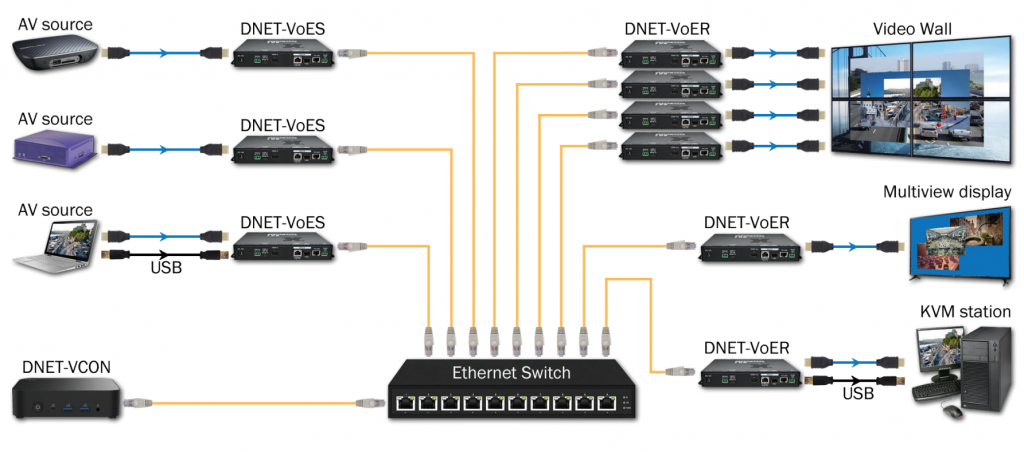
If you’re using a 16x16 switcher and want to add a 17th display, you’ll need a larger chassis. But with SDVoE, you can use an Ethernet switch with any ratio of sources and displays that fits your setup. This can scale however you desire, so long as your switch has enough ports.
SDVoE networks can also support the following without rewiring:
● 1-to-1 routing
● 1-to-many distribution
● Multiviewers
● Video walls
● Keyboard, video, mouse
Where SDVoE Delivers the Highest Return on Investment
SDVoE has a high initial cost, with the 10GbE switch alone costing hundreds (if not thousands), though the price depends on the number of ports you need. However, it’s highly cost-effective in rapidly changing environments, such as universities, control rooms, and simulation labs.
They also offer a good RoI in facilities and setups designed for decades of use, such as:
● Airports
● Hospitals
● Command centers
● Government buildings
Additionally, SDVoE lowers a number of extraneous costs, such as re-cabling labour, the time it would take to alter or upgrade your AV setup, and vendor lock-in risks. Ultimately, SDVoE might not pay for itself too quickly, but its long-term operational efficiency makes it worth the cost.
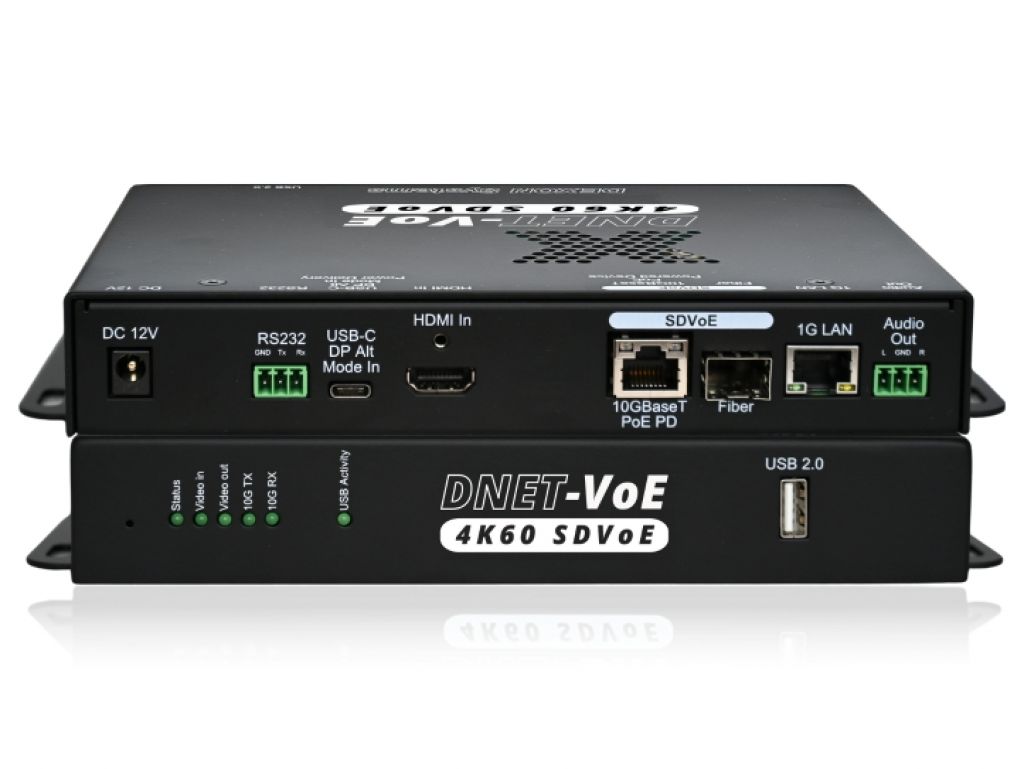
The DEXON DNET-VoES, DNET-VoER boxes and the DNET-VCON box form a full featured audio-video transmission system for demanding projects. They handle HDMI input sources and transfer them to HDMI outputs where the 4K60 4:4:4 resolution can cover unlimited distances. They provide SDVoE compliant solution as matrix switchers, video processors or multiviewers.
Designing AV Systems That Can Adapt Over Time with SDVoE
This is arguably SDVoE’s biggest strength. First, you should design setups to suit your ports and not just the rooms themselves. You shouldn’t worry about how many inputs or outputs you need per room; you can simply think about how many endpoints the whole network requires.
If you do decide to go overboard, keep this to your network; you could, for example, upgrade to (or start with) 25GbE or even 40GbE backbones. Add endpoints as your needs evolve, and still leave switch capacity headroom; bandwidth is still cheaper than construction, after all.
You can also use SDVoE to separate infrastructure from functionality, making rooms much more modular in the process. Your hardware can stay the same - but the firmware will guide how it all fits together. For example, you can turn meeting rooms into training rooms without rewiring.
SDVoE as a New Way to Design AV Systems
SDVoE arguably represents the future of AV setups, though this doesn’t mean that traditional AV over IP is going anywhere anytime soon. This is simply an alternative, though one that arguably eclipses AVoIP’s potential in live broadcasting and similarly mission-critical environments.
If you’d like to learn more about how to integrate SDVoE into your AV tech stack, contact Dexon Systems today.