Sustainability in AV: Why Energy Efficiency is the New Standard
Audiovisual technologies are moving toward a greener future due to a combination of consumer demand and regulatory shifts. Modular, hardware-driven systems are also growing in popularity, with energy-efficient AV systems able to last longer without needing full replacements. The right output can even replace up to 64 screens, letting you run your operation with fewer devices.
In this post, we’ll outline why sustainability is growing in AV tech and how this could work in your - and your company’s - favor.

The Global Responsibility of the AV Industry
Audiovisual technology is everywhere, and each device (be it a video wall, multiviewer, or just a simple monitor) has a carbon footprint. In fact, the TV and streaming industry already generates twice the greenhouse gas emissions of the aviation industry.
Energy-efficient AV systems are essential going forward. This means devices that generally use less power, as well as modular setups that let companies use the same solution for years.
The AV industry should also be more sustainable beyond this, such as by refining manufacturing processes and reducing reliance on rare materials. The end user also bears some responsibility. For example, they should use a device’s power-saving features.
Ultimately, AV products risk generating waste from manufacture to disposal. As companies and consumers alike begin to recognize the damage this can do to our planet, it is the AV industry’s duty to enact change in whatever ways we can.
Regulatory Push: The EU Energy Efficiency Directive
There are already a number of international efficiency targets that are driving the AV sector (and other tech-centric industries) towards sustainability.
One of the main policies here is the EU Energy Efficiency Directive (EED), adopted in 2012 and amended in 2018 and 2023. As the name suggests, it covers the European Union. In its current form, the EED sets out:
● How EU countries should prioritize energy efficiency
● The need to double efficiency improvements by 2030
● Goals to reduce consumption by 11.7%, again by 2030
● Reporting mechanisms for energy investments
● The need for the public sector to lead by example
Though legislation generally does not target the AV industry specifically, it still puts pressure on manufacturers to build sustainable AV infrastructure. After all, the public sector in any country is a massive AV customer.
Performance per Watt: The Engineering Shift
Today’s energy-efficient AV systems are primarily hardware-focused, reducing operating system overhead and overall AV power consumption. This means prioritizing performance per watt, how much you get from an audiovisual device for every watt it uses.
“Performance” here can include (but isn’t strictly limited to):
● Brightness
● Resolution
● Audio clarity
● Color accuracy
● Sound coverage
● Video scaling
● Latency
For example, a 300-watt display with 1000 nits of brightness has a higher PPW than a 500-watt display with the same brightness.
Returning to hardware’s growing popularity, FPGA (field-programmable gate array) systems are especially in demand. These execute instructions as hardware logic, also making use of parallel processing and task-specific optimization to carry out processes more efficiently.
Here’s a closer look at how this compares to software-based AV solutions:
| Aspect | FPGA Hardware | Software/OS |
| Power consumption | Low, minimal overhead | High, OS always running |
| Processing model | Parallel execution | Sequential |
| Clock speed | Lower | Higher |
| Energy per task | Low, task-specific | High, general processing |
| Data movement | Localized pipelines | CPU-RAM-GPU transfers |
| Temperature | Low heat generation | Requires more cooling |
| Scalability | Scales efficiently | Power increases with load |
| Flexibility | Task-focused | Flexible but inefficient |
If performance per watt is your priority, stick with FPGA-driven AV hardware.
64 Inputs, One Screen: High-Density Efficiency
Traditionally, multiple inputs meant just as many outputs. However, modern AV devices, such as video walls and multiviewers, let you spread several inputs across one screen. This may be all a room or team needs, provided you have a display large enough to maintain each feed’s quality.
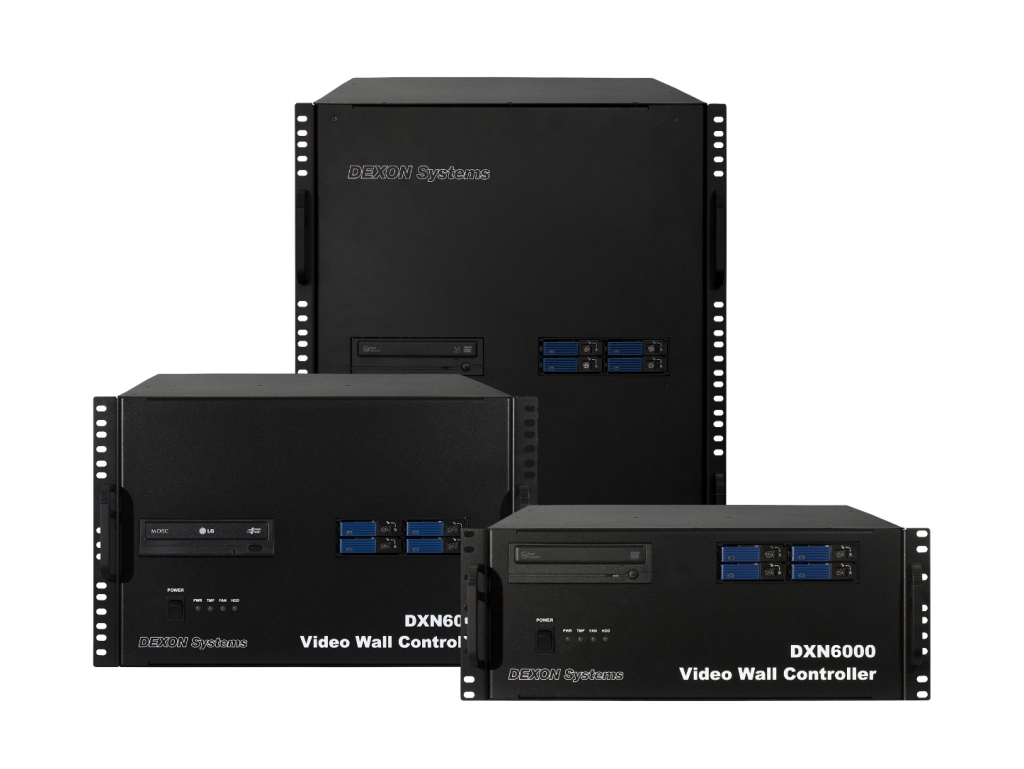
The DXN6064 from DEXON is one such system, offering up to 64 inputs via picture-in-picture. A setup like this is important in mission-critical settings, where team members must check multiple feeds simultaneously.
For example, a security team must be able to view as many security camera angles as possible at any given time. Spreading these out across over a dozen screens massively inflates your AV budget while also making it harder for users to keep watch. Even if they manage it, the cognitive load of reorienting themselves can massively slow down their decision-making.
The DXN6064 system is ideal for these situations. Its 4K60 quality keeps everything crisp, even on a larger screen. In addition, the AV system’s modular video wall architecture can easily adapt to small- and large-scale deployments.
.png)
Longevity and the Circular Economy
A purpose-built AV device that lasts for 10 years is much more efficient than a PC-based system that needs replacing every 3 years. In terms of manufacturing cost alone, the latter will consume three times as many resources. Purpose-built systems are also optimized for AV use and deliver higher performance per watt than PCs with massive idle draws.
Energy-efficient AV systems often use a modular architecture, separating them into “modules” or components. The benefits of this include:
● Being able to repair individual components and extend the system’s lifespan
● Not needing to throw out the whole device if a fault develops in one module
● Lower logistics emissions due to fewer full-system replacements
● Significantly reduced electronic waste across the board
● Less energy used for cooling; many modular systems use optimized airflows
This supports a circular economy, ensuring a system’s materials stay in use for as long as possible while providing the highest possible value.
Investing in a Greener Future
Sustainable AV infrastructure is becoming increasingly accessible each year, as policy changes slowly but surely push the industry in the right direction. To be a part of this green AV revolution, make sure any audiovisual technology you buy is an efficient long-term investment.
Contact DEXON today to learn more about our sustainable AV products and how they can help you or your business.